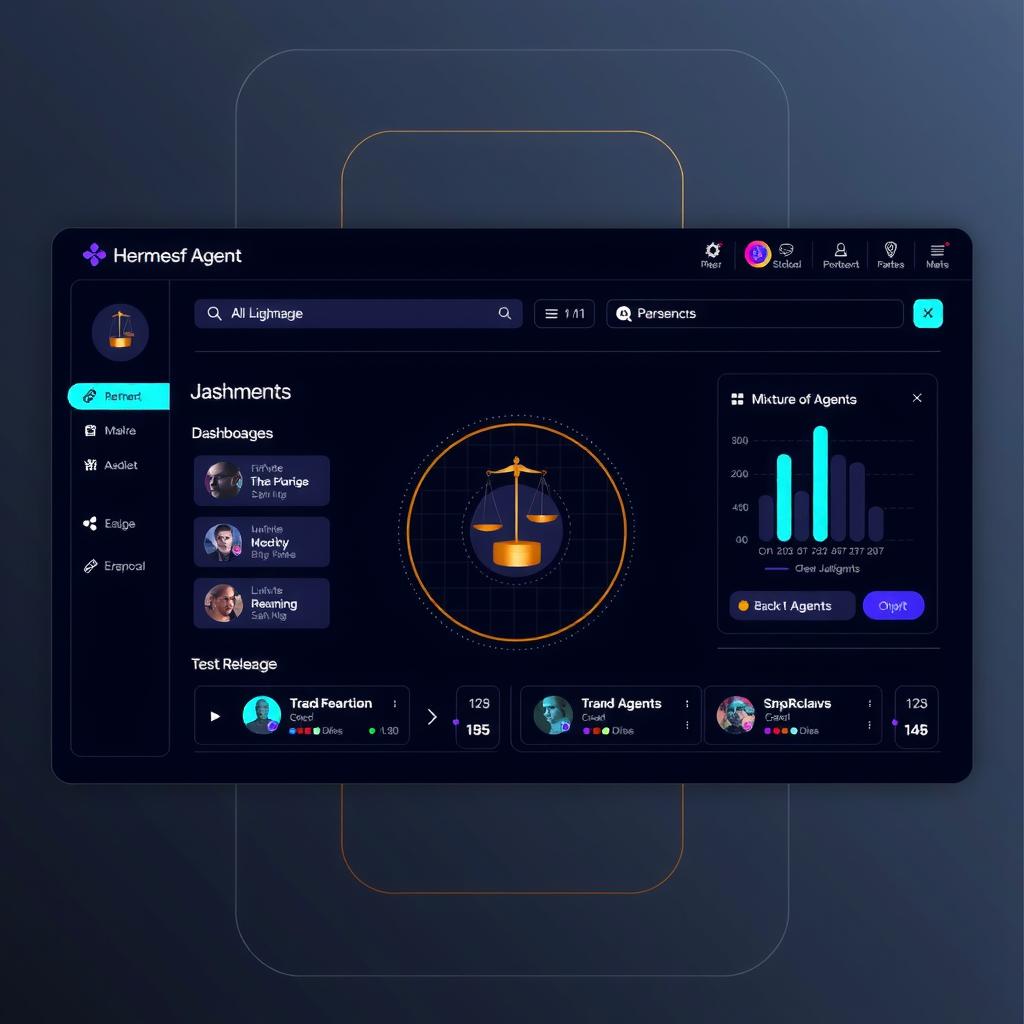
Hermes Agent v0.18.0 'Judgment Release' Clears Zero P0/P1 Issues — MoA Becomes First-Class, Agent Verifies Its Own Work
Hermes Agent v0.18.0 closes all P0/P1, graduates MoA to first-class, adds work verification, /learn, /journey, background subagents, desktop coding cockpit.
Nous Research has shipped Hermes Agent v0.18.0 — “The Judgment Release” — arriving just twelve days after v0.17.0. The headline is unprecedented: 100% of P0 and P1 issues across the entire repository are closed, with the team vowing to keep them at zero going forward. But the release also delivers some of the biggest quality-of-life improvements in Hermes history — Mixture-of-Agents as a first-class model, verification-driven completion contracts, and a /learn command that turns any workflow into a reusable skill.
The P0/P1 Clean Sweep
This release’s defining achievement is the priority backlog purge. Over twelve days, the team — led by @teknium1 and @kshitijk4poor — closed 496 P0/P1 issues and merged 196 P0/P1 pull requests. Every single critical and high-priority item in the repo is now resolved. The final cluster to fall was the interrupt-protected-compression sibling-fork bug (issue #56391), closed on an all-nighter right before the release cut.
With ~1,720 commits, 998 merged PRs, 949 issues closed, and 381 contributors, v0.18.0 is the largest Hermes release by every measure.
Mixture-of-Agents: Now a First-Class Provider
The biggest feature change is MoA graduating from a toggle-able mode to a proper selectable model. Every named MoA preset now appears under a moa provider alongside Claude, GPT, and Grok in every model picker — CLI, TUI, desktop, and gateway. Pick “my-council” the same way you’d pick any model, and Hermes routes your prompt through that ensemble.
Even better, you can now see what each model in the ensemble thinks before the final answer arrives. Each reference model’s full output renders as its own labelled block — you can read GPT-5’s reasoning, Claude’s take, and Grok’s perspective side by side. Then the aggregator’s synthesized answer streams in live instead of appearing all at once after a long silence. The committee deliberates in public.
The Agent Verifies Its Own Work
One of the most philosophically significant changes in v0.18.0 is completion contracts for /goal. Instead of deciding it’s done when the model “feels like it,” Hermes now records verification evidence for coding work — it runs your project’s actual checks and judges completion against that evidence. There’s a pre_verify hook for wiring in custom checks, and a one-time migration to tune the defaults sensibly.
The difference between “I think I fixed it” and “the tests pass, here’s proof” is now baked into the agent’s core loop.
/learn and /journey
Self-improvement becomes visible and steerable. /learn <anything> distills a reusable skill from a directory, a URL, or just the workflow you walked Hermes through five minutes ago — it writes the skill to your CONTRIBUTING.md standards automatically. Teaching Hermes a new trick is now a single command.
/journey adds a learning timeline to the CLI and TUI, showing every memory and skill Hermes has accumulated, with in-place edit and delete. The desktop app pairs this with a memory graph — a playable radial timeline that lets you watch your agent’s knowledge grow over time. Your agent’s memory stops being a black box.
Background Fan-Out Subagents
delegate_task can now fan out multiple subagents that all run in the background — your chat is never blocked. Kick off “research these five competitors in parallel” or “audit these three modules,” then carry on with something else while a small fleet works. When every subagent finishes, their results come back as a single consolidated turn.
Desktop Coding Cockpit
The desktop app evolved from a chat surface into a real development environment. Projects bring a sidebar of your codebases, a coding rail, a review pane, git worktree management, and agent-facing project tools — all backed by a project → repo → lane model. The app also gained a multi-terminal panel with read-only agent terminals that persist across relaunch, PR-style file diffs in chat, and an in-app spot editor.
Scaling and Security
The gateway can now go dormant when idle (scale-to-zero) and quiesce cleanly before restart or migration — without dropping in-flight conversations. Running Hermes for a team just got production-grade.
On the security front, MCP-config persistence attack surface was locked down, cron base_url credential exfiltration was blocked, a non-reusable sentinel for prefix secrets in file reads was added, and an aiohttp CVE floor was enforced across all messaging paths. A credential-exfil hardening wave by @kshitijk4poor closed several long-standing concerns.
Google Vertex AI Support
Vertex AI is now a first-class provider for Gemini models over Google Cloud’s OpenAI-compatible endpoint. Since Vertex has no static API key, Hermes now automatically mints and refreshes short-lived OAuth2 access tokens from a service-account JSON or Application Default Credentials. If your org runs Gemini through GCP, point Hermes at your service account and it just works.
What’s Next
With the P0/P1 backlog at zero and a commitment to keep it there, the team’s attention turns to shipping more surface-level improvements and ecosystem integrations. The blank-slate setup mode (minimal agent, opt-in to everything), further desktop polish, and deeper MCP integration are all on the horizon.
Check the full release notes on GitHub for the complete changelog — and run pip install --upgrade hermes-agent to get v0.18.0 today.